It’s been a minute, I know. I had surgery for trigger finger in both my ring fingers, and until I got that done and was mostly recovered, typing really hurt. (It’s why I went back to drawing; holding a stylus wasn’t nearly as bad.)
The longest bit of typing I’ve done since my hands recovered was just today, when I wrote a bunch of comments on Certain Point of View’s Men of Steel podcast episode about Crisis on Infinite Earths, the 1985-86 DC Comics limited series that reworked the landscape of DC continuity. The original posts are in the Certain PoV Discord server, but I decided to reproduce the posts here.
I agree that Supergirl’s costume looked good sans headband (as it initially appeared when they rolled it out in Supergirl v2 #13). I didn’t mind the headband, though, because IRL it would’ve helped hold back the mane of curly hair that came with it.
The Earth-Two Superman’s costume in CoIE was just the latest rendition. DC had changed Superman’s emblem in Action Comics #484 to match a classic painting hanging in the DC Comics offices at the time. Then, right in the middle of a JLA/JSA team-up, Perez changed the emblem, possibly at Roy Thomas’s request, but if you go back to the 1970s, DC started distinguishing between the versions of Superman by giving Kal-L graying temples and a slightly different emblem in Justice League of America #107-108. Fun fact: the name “Jor-L” first appeared in a Slam Bradley story pre-Action Comics #1 , referring to a detective from the future, and the name is derived from “Jerry Siegel,” co-creator of both Slam Bradley and Superman. For years, writers had been depicting Kal-L as either natively less powerful than Kal-El or as losing his powers as he aged, but by the time of Infinity Inc., at least, it seemed like Roy Thomas had retconned that out.
Side note: ICG published an Official Crisis on Infinite Earths Index and an Official Crisis Crossover Index in the late 1980s, and in one of those, the writer(s) posited the existence of an “Alternate Earth-Two” that followed the actual Golden Age stories (e.g., the Daily Star becoming the Daily Planet in the 1940s). (Side side note: I read that the reason for changing the newspaper’s name was because the Superman comic strip would sometimes run in a city that had rival newspapers, and the one with “Star” in the name wasn’t always the one running the strip.)
Although Earth-Prime was supposed to be the “real world” up to that point, Superboy-Prime wasn’t its first superhero. That distinction went to a character named Ultraa, introduced in Justice League of America #153 (1978).
BTW, another Earth-Two character whose costume design fluctuated wildly was Earth-Two’s Wonder Woman. Just look at her appearances in JLA-JSA team-ups and the brief period when DC focused on the Earth-Two version in the 1970s, and you’ll see what I mean. In fact, the TV show influenced the design of both Wonder Women in that it modified her boots and belt; before the TV series, both versions had a white belt (not gold, except for a story or two after her non-powered period, but that was a mess), and neither had a vertical white stripe on their boots (the Earth-One WW had plain red boots like she did on Super Friends). Longtime JLA penciller Dick Dillon was exceptionally inconsistent when drawing Earth-Two versions of the Big Three, really, except that he remembered not to put a yellow oval around Batman’s emblem.
The weird groupings of Asian superheroes by powerset seem to be just a lack of originality on DC’s part.
Rising Sun and Thunderlord both first appeared in the pages of Super Friends #8 (1977) and were “canonized” on Earth-One (since Super Friends wasn’t really Earth-One, despite E. Nelson Bridwell’s attempts to fit it in) in DC Comics Presents #46 (1982).
Sunburst debuted in New Adventures of Superboy #45 (1983).
Thunder and Lightning’s first appearance was in New Teen Titans v1 #32 (1983).
As I understand it, the question of how to end CoIE was constantly in flux. At one point, the idea was to leave the five earths bound together with the overlapping “warp zones,” then it became “let’s merge all the universe together, but only as of the fixed point of the Crisis” (meaning it would’ve been possible for Superboy and Supergirl to still travel to the future and work with the LSH), and then it became “nope, we’re wiping the slate clean” (or so they thought). That’s part of why LSH v3 #18 is the only “official” Crisis crossover, and it consists of explaining how the Infinite Man had been holding back the events of the Crisis (while DC editorial figured out what to do with it). Similarly, Roy Thomas claimed at the time that he rewrote the origin of Mekanique to include holding back the events of the Crisis so that he could align the last issue of All-Star Squadron with the rest of the post-Crisis DCU.
The easiest way to explain “Whatever Happened to the Man of Tomorrow” is that it’s set on Earth-One during the undocumented time when Superwoman was in the past with at least partial amnesia (see DC Comics Presents Annual #4), and Captain Marvel crossed over from Earth-S, making that the Earth-One Wonder Woman who briefly appears. It’s a messy story anyway, because among other things, it doesn’t explain why Lana wouldn’t have had her biogenetic transformation ring from her Insect Queen days as a backup when fighting the LSV.
DC editorial really dropped the ball by letting John Byrne redo Superman as the only surviving Kryptonian and enforcing that by retconning Power Girl’s origin and sending Superboy-Prime off to limbo. An easier solution would’ve been to keep Power Girl as a Kryptonian and send Superboy-Prime to the future with the LSH, making it possible for all three to be the last survivors of Krypton–just different Kryptons.
Hell, if they hadn’t sent Superboy-Prime off to limbo with the Earth-Two Kents, they could’ve used him as the Pocket Universe Superboy. He could’ve made a deal with the Time Trapper to save Earth-Prime, but instead the Trapper created the Pocket Universe and trapped Prime in it, forcing him into a retconned role with the LSH.
While I agree the post-Crisis DCU was a mess, I think the multiverse concept (as it was) was already fraying by the time DC decided to clean house.
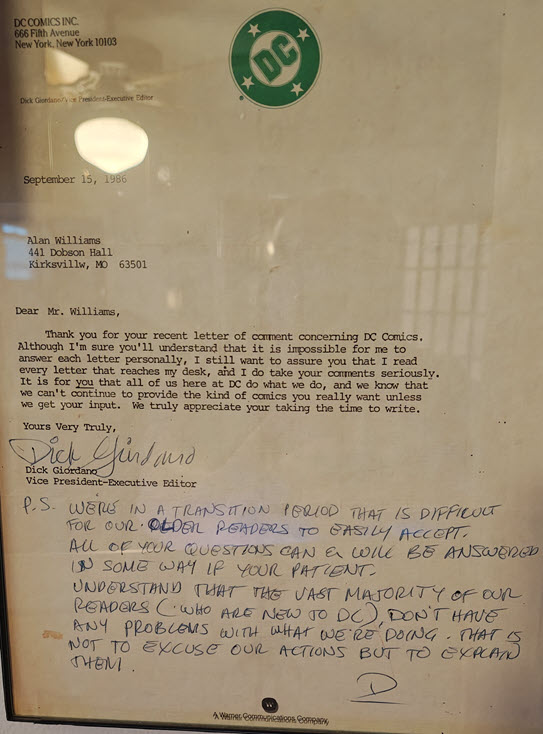
A little context: For anyone who didn’t know, I started reading at age 3, in 1971-72, and my older brother’s comics were some of the first things I read regularly. I had no problem understanding the multiverse as it was, and at first, I was kinda put off by the new DCU (CoIE ended a few months before I turned 18). I even wrote to DC about it and got a letter back from Dick Giordano himself. (I’ve told this story a few times.) Giordano’s handwritten PS changed my opinion about the retcons, and I’ve been more open to rewrites ever since. It read,
We’re in a transitional period that is difficult for our older readers to easily accept. All of your questions can & will be answered in some way if your [sic] patient.
Understand that the vast majority of our readers (who are new to DC) don’t have any problems with what we are doing. That is not to excuse our actions but to explain them.
D
My vote for the best reconception of the multiverse, however, is Hypertime as created by Mark Waid, with its idea that sometimes a timeline branches off and stays branched off, while others fold back in, which allows writers to create both parallel-universe stories and “oops, we changed the flow of history” stories.
If you’re interested in Superman and people talking about Superman, definitely check out Men of Steel.


Leave a Reply